
Library
Library is the folder WonderPen uses to save documents and data, usually ending in .wplibrary.
When first launched, WonderPen will show you an interface similar to the following:
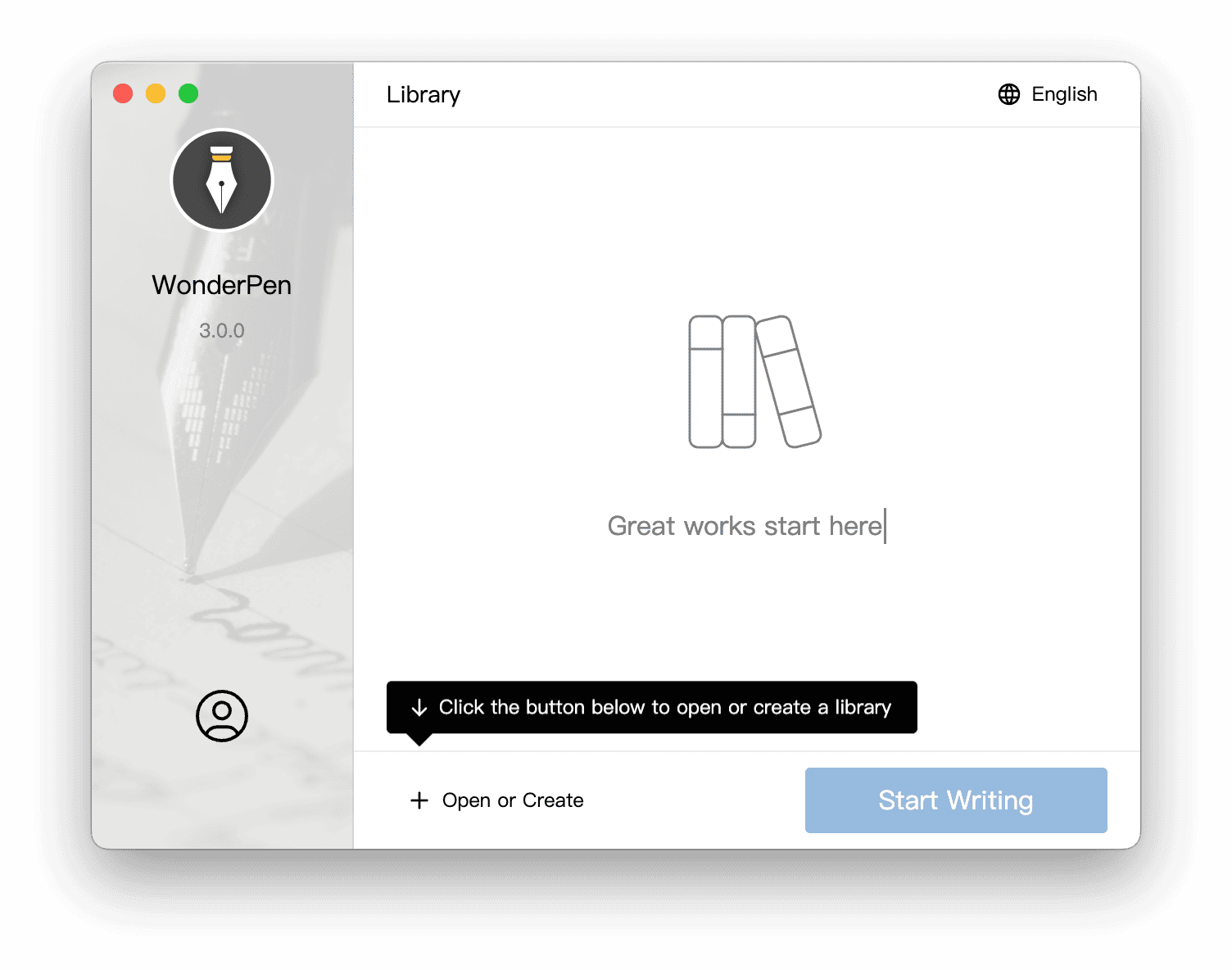
Click + Open or Create to open or create a library.
Open or create a new library
After entering the main editor interface, click the Library button on the left side of the top toolbar to open the Library drop-down menu:
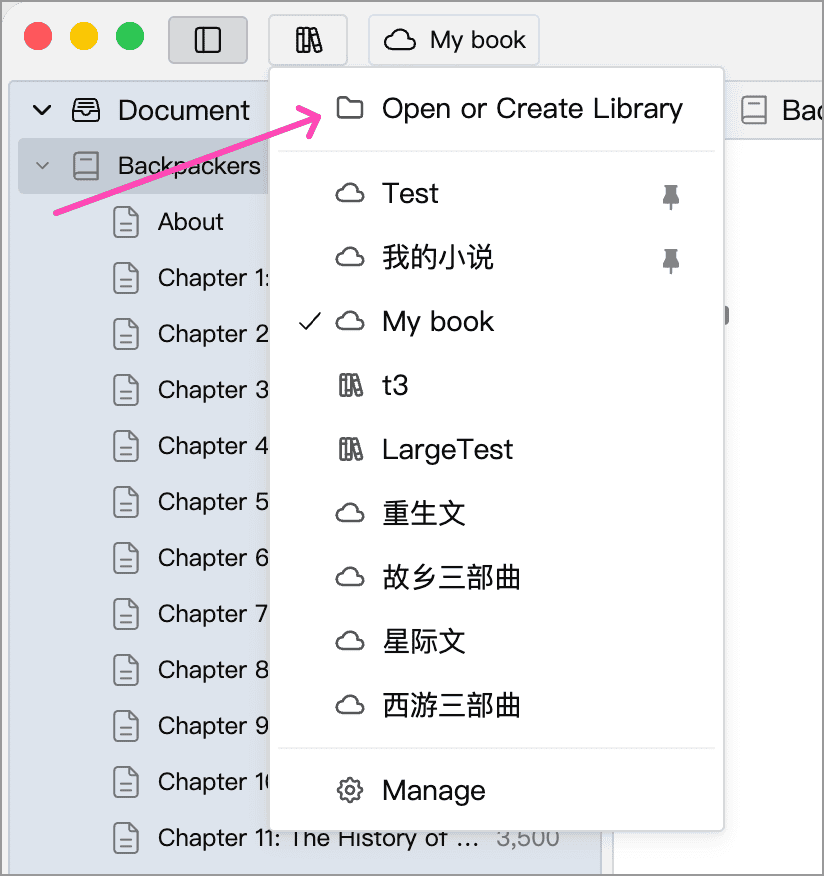
This menu lists recently opened Libraries (the default Library is always listed). You can open or create a Library here, or select another Library to switch to it.
Select Open or Create a Library to open the Library panel. You can also select Open or Create a Library from the File menu in the top toolbar.
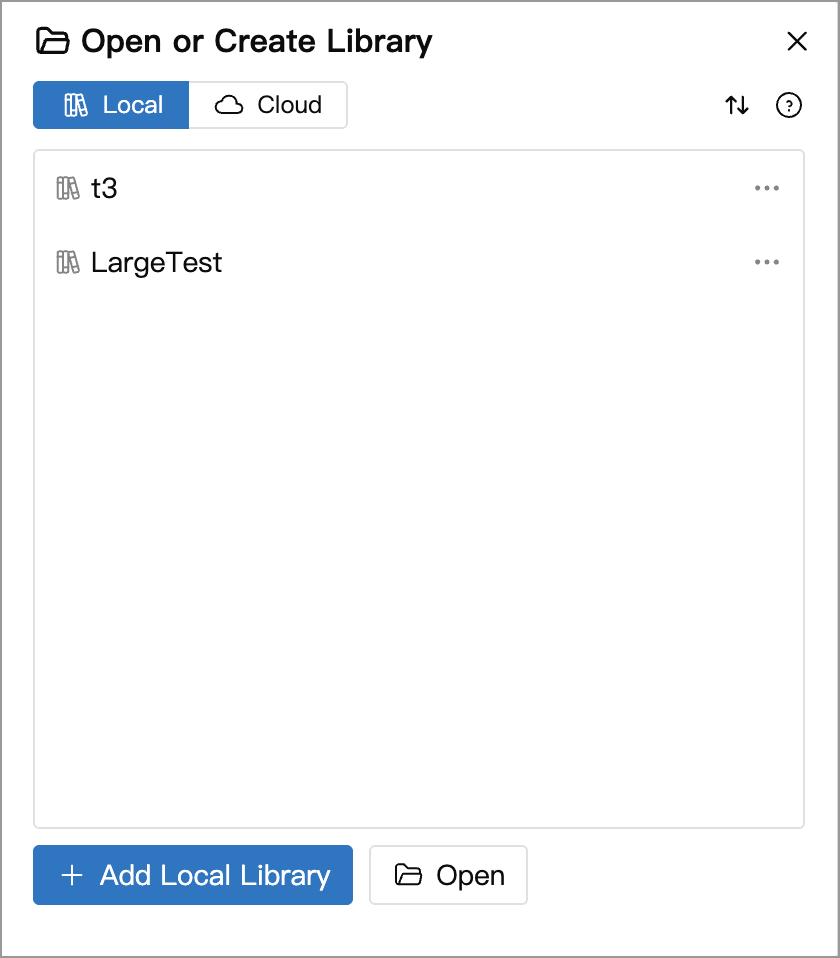
There are two types of Library: Cloud Library and Local Library. Data in a Cloud Library synchronizes to WonderPen's servers, so that you can keep your writing progress in sync across devices. Data in a Local Library is stored entirely on your device and is not uploaded to WonderPen's servers.
Choose the type of Library that suits your needs. For more information, see New Library.
Local Library
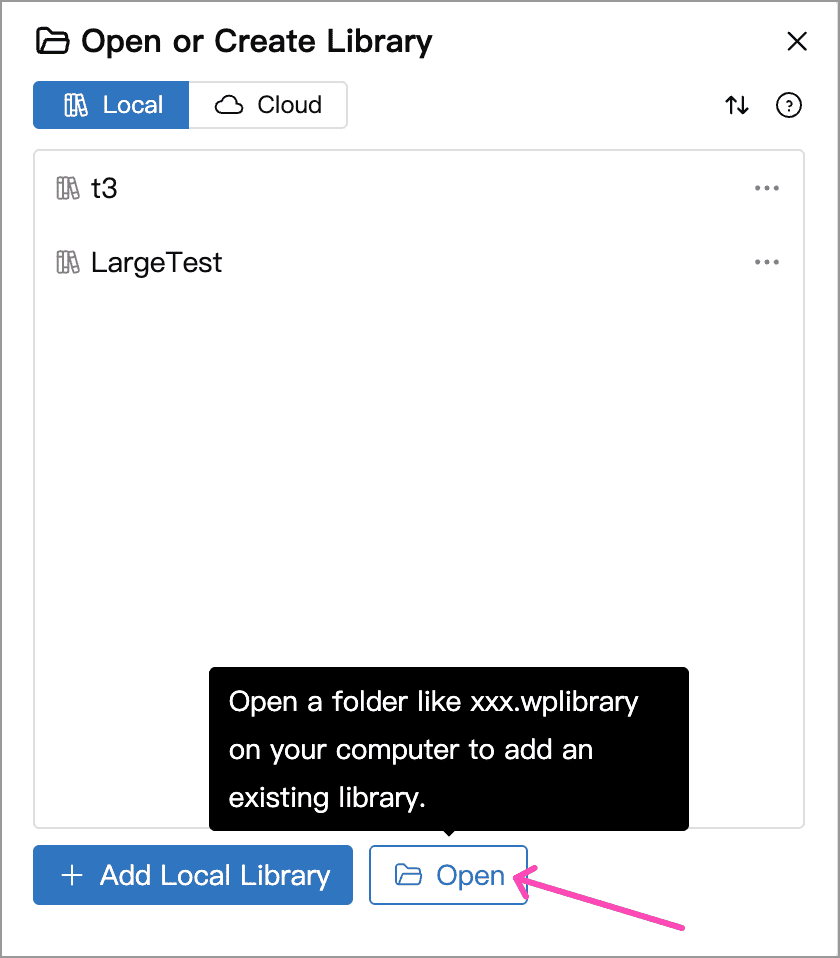
At the top of the Open or Create a Library panel, select Local from the Local and Cloud switch to open or create a Local Library:
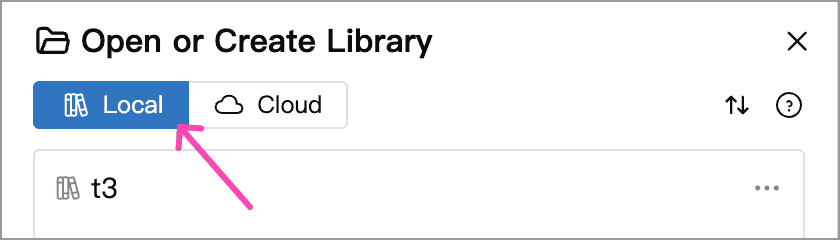
You can also open a Local Library that already exists on your disk. Local Libraries are generally folders ending in .wplibrary; select Open in the lower-right corner of the panel:
Cloud Library
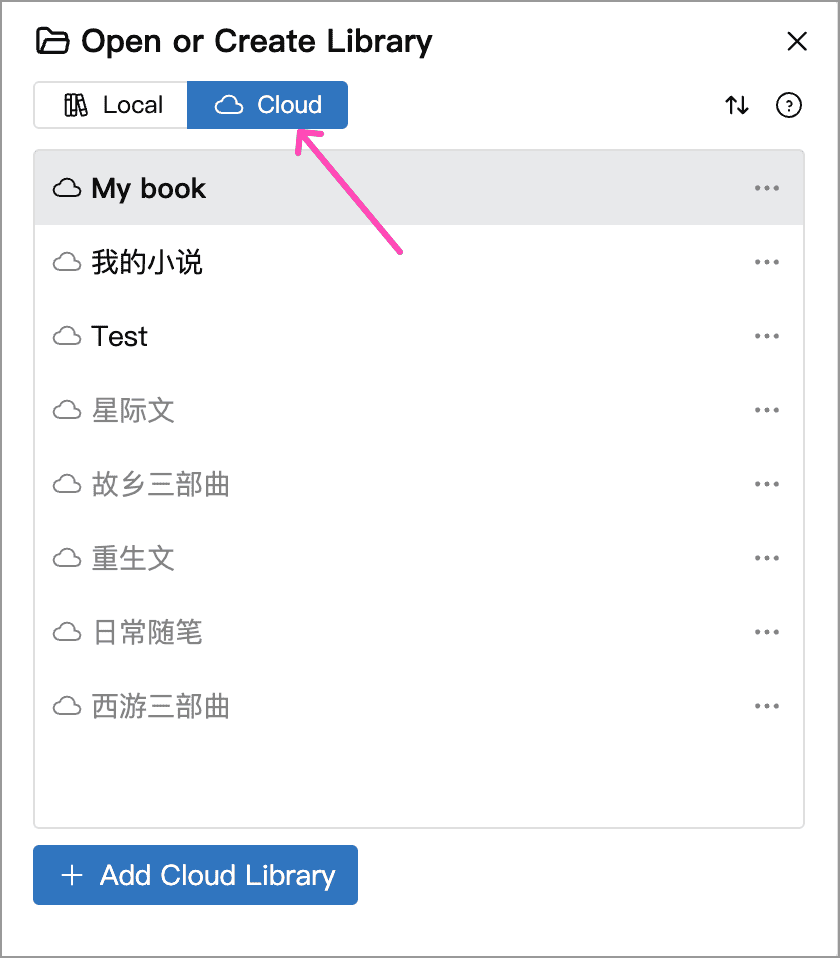
Select Cloud at the top of the panel to view the Cloud Library list or create a Cloud Library:
Open in a new window
You can also right-click a Library and select Open in New Window to open it in a separate window.
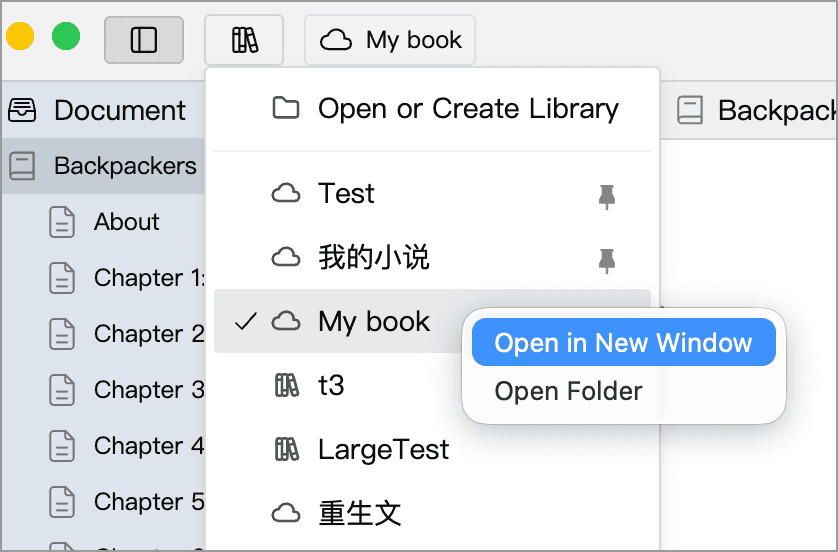
Starting with WonderPen 2.0, you can use multiple windows. You can open the same Library in multiple windows, or open different Libraries in different windows.
When the same Library is open in multiple windows, changes made in one window are synchronized to the others.
Multiple windows are useful when you need to refer to content in the current Library or another Library while writing.
Library Info
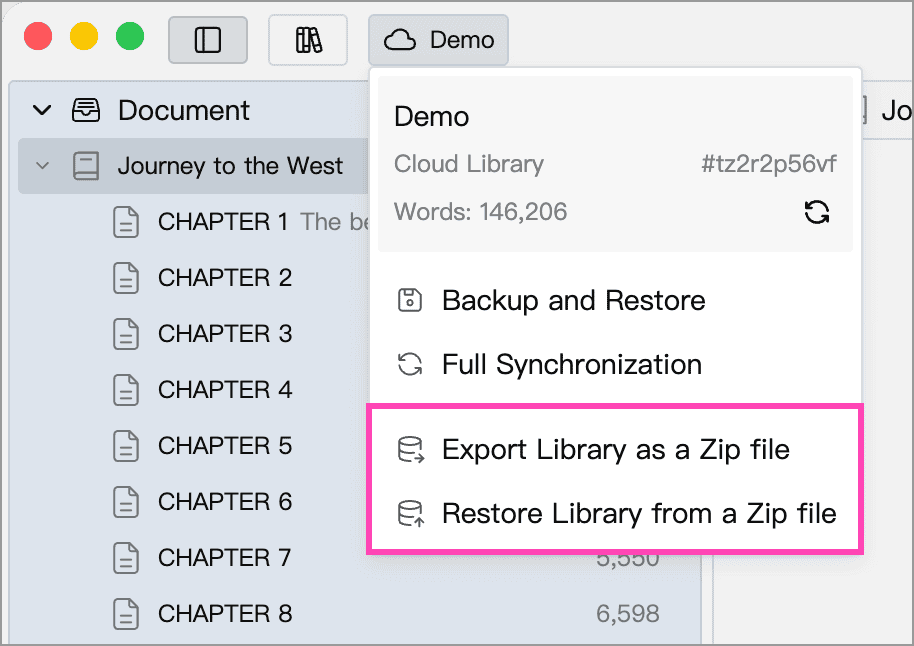
Click the Library name on the left side of the top toolbar to view information about the current Library in the pop-up menu:
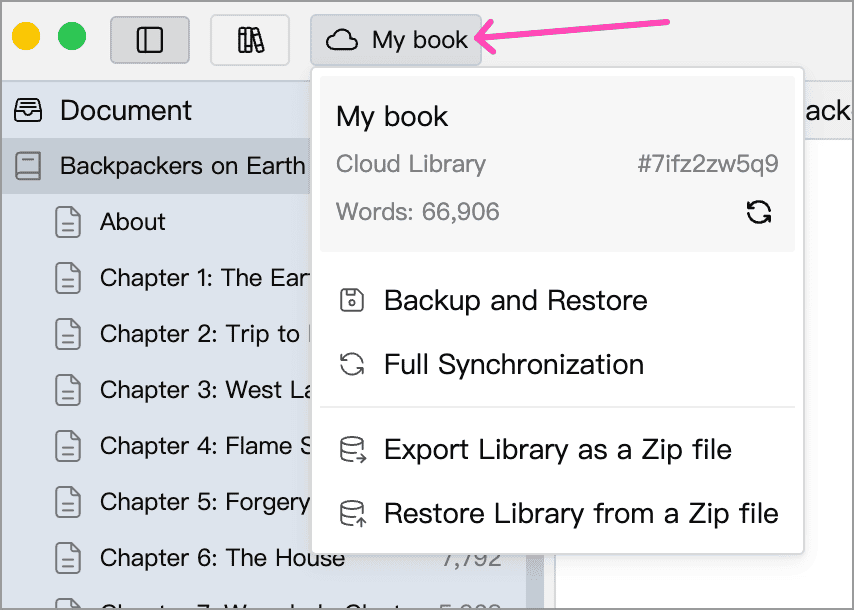
Key information includes:
- Library name
- Library ID (Cloud Libraries only)
- Total word count, which can be recalculated with the refresh button on the right
You can also back up, import, and export the Library here.
Export the library as a Zip file
The library can be exported as a Zip file so that you can back up, migrate, and share data.
Click the name of the current Library in the top toolbar. The pop-up menu includes Export Library as Zip File and Import Library from Zip File:
For specific operations, please refer to the Export as Zip File section.
The Default Library Deprecated
In version 1.x and 2.x, to help new users get started quickly, WonderPen will automatically create a default library when first launched. If you have not set up a library, WonderPen will save documents and data in the default library. The default library is located in the data folder allocated by the system for WonderPen. For the specific location, please refer to this document.
The default library cannot be moved, but if necessary, you can copy it to another location, or export it first, and then import it into a newly created library.
Starting from version 3.0, WonderPen no longer automatically creates a default library. To start writing, you need to manually create a library, or select an existing library at startup. If you no longer need the default library, you can delete it in the open or create library interface.
Note
Starting from version 3.0, WonderPen no longer automatically creates a default library.
How to move or rename a library?
Please refer to How to rename a library?
About data synchronization of library
Cloud Libraries have built-in synchronization. Changes are automatically synced to WonderPen's servers. When you open a Cloud Library, its latest data is automatically downloaded from the server.
Local Library data is stored locally in folders and does not sync automatically. However, you can store an additional backup of your Library in a cloud-drive folder, such as Dropbox, OneDrive, Nut Cloud, Baidu Netdisk, or Tencent Weiyun, to synchronize backups across computers. For details, see Sync with Cloud Drive.